Ironically the most stable part of building AI-powered software products over the past few years has been change. Software teams push AI models to their limits. Those limits get addressed by new model releases, which push software teams to do more. That exposes new limitations and the cycle repeats. So where are we now?
But first... where have we been? Over the past few years, AI products evolved from models powering features behind the scenes, to people talking directly with models (chat), to models deciding which tools to use and how (agents), to agents coordinating the work of other agents (orchestration). Each made new kinds of AI products possible.
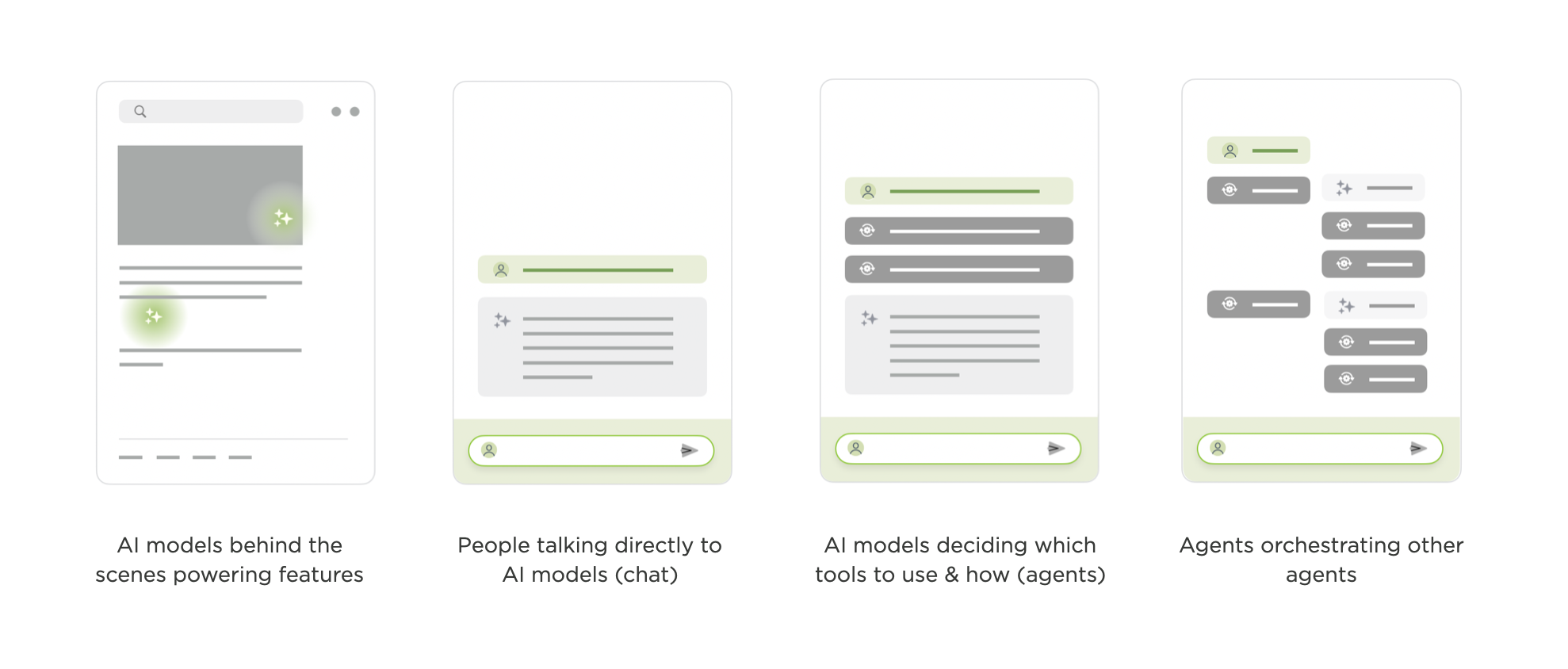
The same is true today with a new pattern I'm seeing repeatedly. In the absence of a better name, I've been calling it self-driving software. Self-driving software is an agent orchestration system with access to deep domain-specific data and the tools it needs to act on it.
Goal-directed agents watch specific datasets for changes and act accordingly using a unique set of tools and scaffolding that helps them run. People get pulled in only for the decisions or actions the agents cannot or should not take themselves. Their feedback makes the system smarter over time. Once set up, the system mostly runs itself with occasional steering from humans. Hence... self-driving software.
As always, examples help. Aria is a hardware and software stack for optimizing AI data center networks. It collects microsecond telemetry from networking hardware, its agents look and act cross that data on opportunities to optimize performance and issues to fix. People running the network only get pulled in when needed.

Trace follows a similar pattern but for cyber security. It gathers behavioral data across a company's infrastructure adversarially (meaning there's no opting out), its agents notice and investigate any behaviors that look unusual, and the security team only sees the issues they actually need to address.

At a much smaller scale, we gave a set of agents the goal of optimizing search ranking for one of our Web sites along with access to the data they needed from Google Search Console, Bing Webmaster Tools, Vercel Web Analytics, and a few APIs. The agents built a small system to pull the numbers, run experiments, keep what's working, and repeat until they reach their goal or need to pull us in for a decision.

Across these examples, the basic components of self-driving software remain the same. What changes is the data, the goals of the agents, and the tools they use. In each case, though this kind of software doesn't look like the databases, dashboards, and forms that defined SaaS products for the past twenty years. At least not to humans. Agents could still make and use those components, but people no longer need to. They just steer the agents (perhaps with as-needed UI).
So what does self-driving software mean for people who design and build applications? When agents build the tools they need and people only show up to steer, design work shifts to helping people set goals and what they need to take the wheel. For now...